Showing posts with label instrumentation. Show all posts

Wednesday, July 25, 2012

Instrument Cluster Pinout

Took a closer look at the underlying circuitry of the instrument cluster yesterday and managed to map out the pins. Perhaps this would be useful later if you wish to troubleshoot indicator related problems.

Left Connector, close to clock.
1. Brake Fluid Level Warning. Goes to brake master cylinder.
2. Oil Pressure Warning. Goes to oil pressure sender.
3. Indicator Lamps Check. If this pin is grounded, all indicator lamps should illuminate. This allows you to see if any lamp is broken.
4. High Beam
5. High Beam
6. Brake Light Warning. This indicates if one of the lamps on the brake light is broken.
7. Battery Acid Level Warning. I have not personally seen any car battery which allows this but i could be wrong. This goes directly to A (the A to D mark above the clock).
8. ACC power supply to clock.

The circuit which is marked with A, B, C and D above the clock is connected as below.
A goes to 7 on left connector
B goes to IGN (+), pin 15 on middle connector
C goes to Battery Acid Level Warning
D goes to Ground

Middle Connector, close to speedometer.
9. Left Turn Signal
10. Right Turn Signal
11. Not Connected
12. Ground (Earth) for Water Temp and Fuel Level gauge
13. To Fuel Level Sender unit
14. To Water Temp Sender unit
15. IGN (+) to all Indicator Lamps
16. Not Connected. Goes to empty indicator below Battery Acid Level warning.

Right Connector, close to tach.
17. Ground
18. +B (constant connection to battery for clock memory)
19. Door Open Warning
20. Fog Lamp? Can't be sure.. The indicator that looks like a lamp with three ray beams.
21. Hand Brake Warning (parking)
22. Instrument Cluster Illumination
23. Instrument Cluster Illumination
24. Tach Signal input to Tachometer

I could be wrong but i did my best to avoid any mistakes. At least this should give you some help to trace any problems later.

Here's the warning lamps.
1. High Beam
2. Brake Light Warning
3. Oil Pressure Warning
4. Battery Acid Level Warning
5. Brake Fluid Level Warning
6. Charge Lamp
7. Fog Lamp?
8. Door Open Warning
9. Handbrake Engaged

Saturday, July 21, 2012

Fuel Level Gauge & Sender

Bought this cheap universal fuel level gauge out of curiosity on how it works.

Dissecting the gauge was easy. Pry the outer ring using a screwdriver and pliers. Just be careful not to damage the glass face.

Undo the three nuts holding the needle circuit and insulating plastic.

Here's the gauge's internal circuit.

Circuit diagram.
Looking at the circuit diagram above, one is able to deduct that the ground (-) is not necessary to be connected. You can just connect (+) to ignition line from coil and (S) to fuel level sender, grounding the other end of the sender to close the circuit. To be noted is that the (-) is not connected to the gauge's body. The trimpot is there to adjust the gauge needle to show the actual fuel level.

The more current flows through the electromagnet coil inside the gauge, the closer the needle will point to Full. Without any current, the needle rests on Empty. This means your fuel level sender float should have high resistance on Empty and low on Full. I decided to check whether this is the case with my fuel level sender.

Charmant's fuel sender is confirmed to be the same as KE70's. Confirmed? Yes, i wrote about this earlier.

Here's the connector on the sender. There are two pins. One goes to the gauge and the other gets ground.

Part number on the float.

So, did it pass the test? "Tank"-fully yes.. It gave 10.3 ohm when the float's at Full position and 113.1 ohm at Empty. This will also serve as correction to my earlier post which states that it works the other way around.

Finally, a little customizing and now i have my very own Angry Birds fuel level gauge! lol..

Monday, October 3, 2011

SLC DIY Wideband Lambda Installation

On the last day of my work leave period, my SLC DIY Wideband Lambda was installed and running successfully. Glad there was no drama on the installation process. I guess i haven't lost my soldering skill after all.

First thing i did was to get a steel nut that fits the Bosch O2 sensor as there was no bung supplied with the kit. From there, it was only 30 minutes at the exhaust shop to get the bung welded on the downpipe, just below the front passenger floor deck. One thing to make sure is that the sensor has to sit at an angle from vertical, preferably around 45 degrees. This is said will help reduce sensor damage from thermal shock due to condensation on cold starts.


Not exactly 45 degrees from vertical, but good enough i guess.
Fiddled around with some wires, plugged in the connectors, zipties for neatness, applied power, executed hardward calibration and VOILA!


Just make sure to use the latest SLC software to allow communication with the controller. I didn't and had to redownload the latest one. From there, everything went smooth. Here's a capture of my SLC Config software.

It's not yet wired to my Megasquirt but it should be very easy with just one wire to connect.

Saturday, June 11, 2011

SLC DIY Wideband Lambda Assembly

Got some spare time today and decided to assemble the SLC DIY Wideband Lambda Controller that was delivered two or three weeks ago. Excited to do it, to be honest, since soldering stuff and electronic kits are my hobbies since junior high. Now, i've got the chance to apply these hobbies for my other one: working on The Dog.

Since i'm assembling this away from Jakarta (and my car), i'll only focus on the electronic part first and skip the wiring and welding of the O2 sensor bung later. These are some photos of the build in process.

The kit supplied is pretty neat and easy for DIYers to work on. Every component is wrapped and labelled individually so you'll save a lot of time from having to identify them one by one.


With so many components and parts involved, i was worried that there might be some parts missing. However, as the build progressed, my worries too gradually dissipated. Truly everything you need is included in the kit. Here's the resistors and diodes soldered in place.


The kit didn't include any manuals or documentations. However, those can be downloaded on their website. You can find them here. The guide itself was very clear and helpful. It minimizes possible mistakes and gives you warnings before you do something you might regret. You can actually "feel" the guide was written from actually working on the kit. For example, it'll warn you to cut off leads of the 7-segments since it might cause short to the main board. You can't see this if you don't build the kit yourself.


I also bought the optional boost sensor with the kit but i decided to not install it yet. With no boost sensor soldered to the board, i also didn't install the switch which toggles the display between AFR, boost and EGT. For now, i'll only use the display for AFR reading. Installing the boost sensor can be done later.


I started building the kit at 11.00AM and finished by 18.00PM. Yeah, i took my time. Besides, i had to pause as The Incredibles was showing on Star Movies.. lol. Here's the kit all done, front and rear view.


As i said, everything you need to build what you see above, is included in the kit. Even the screws to hold the main board to the case (which i earlier thought they forgot). Final check as informed by the guide seems to show no problem. Let's hope it actually runs when i get to install it on The Dog later.

By the way, the kit i'm building is the SLC DIY 1 which is now no longer offered on the website. A bit shame actually as the successor, SLC DIY 2, is more expensive. Even the boost sensor is no longer available but this is more of a good news as now they supply the remote version, meaning you don't have to solder the sensor to the board (and drill a hole on the display case for the air pressure line). Instead, you can bolt the sensor to the firewall, close to the engine. Just like most MAP sensors.

If you're good with soldering, this the best bang-for-buck solution for Wideband Lambda Controllers. I highly recommend this. It's simple and everything just integrates nicely for that professionally built look. Your friends won't realize this is DIY!

Saturday, March 26, 2011

DIY Wideband Lambda Controller

Another step closer to turbocharging The Dog, or to any destination point actually since it's not really related to forced induction, i just bought a DIY Wideband Lambda Controller of the net. It's the Sigma Lambda Controller, SLC DIY from 14point7.

Features as copied from the web:

  • 0.01 Lambda accuracy
  • 4 digit display
  • Pressing the face plate button cycles between; AFR, EGT, Boost, display
  • Boost reader with optional onboard boost sensor
  • EGT reader with optional EGT probe
  • 0-5v EGT linear output
  • USB connectivity
  • RPM Pickup
  • Seven 0-5v analog inputs
  • Real-time datalogging
  • Programmable Linear Output
  • Programmable Narrowband Output
  • Over voltage protected
  • Reverse voltage protected
  • Fused design
What interests me the most is that it can read Boost and EGT apart from AFRs. Usually AFR readings are only useful on dyno runs and tuning. Once your ECU mapping is set, you don't really need AFRs anymore. With the feature aforementioned, i can still use the box to read Boost. That's why i opted to buy the Boost sensor as well. It also has an output to communicate with my Megasquirt so tuning should be easier. It works with Bosch 17014 Wideband Sensor.

It's on its way to Indonesia and hopefully will arrive by next week so i can start soldering the parts on the weekend.

Friday, July 24, 2009

Razo Horn Knob, Volt + Amp Meter

Bought these goodies online today:

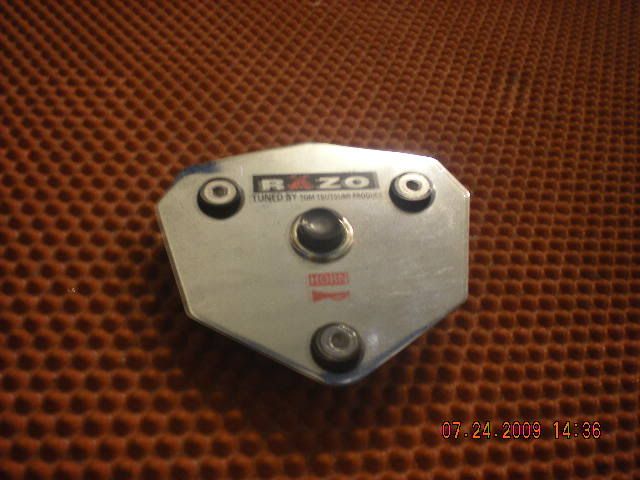
Razo Horn Knob

Volt + Amp Meter

I bought the Razo horn knob because the original Sparco horn knob that came with my steering wheel would no longer fit since i also put a quick release hub. I decided to buy the volt + amp meter also because it was sold by the same seller and offered with a good price.

Wednesday, July 8, 2009

DIY Dashboard Panel Part 3 - Mockup Finished

During my holiday in Jakarta, i managed to finish the design for my dashboard panel. I encountered a problem which reminded me of the most important thing in dashboard panel design: measurement. I found out that day my 3-3/4-inch tachometer is still too wide to be installed inside the panel! I bought the tach online and didn't make sure it will fit to the panel before buying it. So this panel mockup is off to the garbage bin. I also found out that i need to reduce the switches and lamps for aesthetics reason. Below pic shows you the items removed from the design and how the tach is slightly too wide to be placed on the cardboard panel layout.
Well i guess i have to put the tachometer somewhere else. After some measuring and pinpointing hole locations..
.. below is the end result of the mockup. Next step is to transfer this design to an aluminum sheet to have the sheet cut following the design.
I can only fit five lamps and two toggle switches on the panel. So i decided to remove e-brake or check engine light, depending whether i can get a check engine light working for my ECU or not, and i also remove the fuel pump switch.

I managed to salvage some 1mm thick aluminum sheets from a glass display maker. Now that i got a hold of the aluminum sheet, i think it is slightly too thin to hold those gauges firmly but i decided to give it a go first. If it turns out being too wobbly for the panel, i'll have to find thicker aluminum sheets.

I brought the cardboard mockup and aluminum sheets to a lathe and milling workshop. Sadly, the price they offered was too expensive.. I had no more time to ask other workshop because i had other business to do while in Jakarta. So i guess the aluminum panel will have to wait..

Sunday, June 21, 2009

DIY Dashboard Panel Part 2 - Low Fuel Warning Circuit

Since i failed to find a 2-inch fuel level gauge that looks similar to my other gauges, i decided not to install it. However, since i still need to know if i have enough fuel, i need some kind of warning lamp to remind of of low fuel volume. Actually, i was surprised why didn't i think of this before. This is much useful than a fuel level gauge. I don't need to know how much fuel left in my tank, i just need a reminder for me to fill up the tank so a warning lamp is the way to go! It takes less space and it should cost less to build.

Fuel level gauges are actually amp-meters. It measures the variation of current caused by varying resistance in the fuel level sender. It all goes down to the Ohm law:
Voltage = Current x Resistance
where voltage should be constant somewhere around 12 volts.

There could be slight variation but basically, the circuit is wired as such:
If you've worked on fuel tanks before, you'll see an arm attached to a floater on the fuel sender unit. This floater will always float on the surface of your fuel. Thus, it would be high on full tank and it would be low on low tank. The arm is attached to a pointer which... uummm.. points to a certain position on a resistive material, which could be a wire wound or a simple carbon track. So, for those familiar with electronics, a fuel level sender unit is basically a potentiometer. Below is an example of a fuel level sender unit.
In short, it works like this: fuel volume --> floater position --> pointer position --> resistance --> current --> amp-meter! Real simple, right?

The problem is, the resistance in the sender varies between makes and models of the car. I need to know what is the resistance for both full and empty position in Daihatsu Charmants. A dude in the local Daihatsu Charmant mailing list told me that there is a "KE70" writing on the fuel level sender when he opened up his Charmant tank recently. So i'll assume the sender unit is the same with Toyota KE70s*. Upon googling, i found that Toyota KE70 fuel sender unit spec is as follows:

empty = 3.0 +/- 2.1 ohm
1/2 = 32.5 +/- 4.8 ohm (float is 28.5 degrees off empty)
full = 110.0 +/- 7.7 ohm (float 57 degrees off empty)

putting those values into a graph, it would look like this:
So, as can clearly be seen from the graph, the sender is a non-linear variable resistance. Now this is important: determine at what fuel volume would you like your warning light to turn on? I decided on 25%. At 25%, the resistance on the sender would be in between the ohm at empty and at 50% fuel volume. Although it's non linear, i'll just assume the value using the average ohm value since it's not really crucial so (3 ohm + 32.5 ohm)/2 ~ 18 ohm. So what i need to do is design a circuit which would turn on a light when the fuel level sender is below 18 ohm since that means the fuel volume is less that 25%.

To achieve aforementioned purpose, i'll use a cheap LM741 IC. LM741 is an operational amplifier (op-amp) which has 8-pins dual-in-line package. Discussing how op-amps work would really be boring (as if this post is not already boring!) so i'll skip it and go ahead to the circuit design:
The LM741 inverting input is connected to a reference voltage (which is 6.8 volts as determined by the Zener diode). The Fuel Sender and Rx forms a voltage divider and connected to the non-inverting input. At above 25% fuel volume, the voltage on the non-inverting input should be higher than 6.8 volts so the output will remain high which keeps the lamp unlit.

Now, we will determine the value for Rx. At 25%, the fuel sender unit will measure 18 ohm. This resistance value combined with Rx should form a voltage divider which outputs 6.8 volts. We'll assume the supply voltage as 12 volts. Using voltage divider principle, we can determine Rx as follows:
6.8v / 12v = 18ohm / (18+Rx)ohm
Rx = 13.76 ohm.

I think the closest available resistor value is 15 ohm so we'll use it.

A note on the lamp: i don't know how much current can the LM741 sink on the output pin. So be safe and use the least wattage you can find for the 12 volt lamp. A 3-watt 12 volt lamp would flow 250mA on the pin and i think it's already too high for the LM741 to handle. You can use a PNP transistor driver before the lamp just to protect the LM741. Other way is to use a LED with resistor..

All of those components should cost very cheap and can be put inside a small housing. So, start heating that soldering iron and enjoy the smell of tin and resin..

I'll update this post when i have finished soldering.

(*) = While upon ACTUAL comparison, the fuel level sender units look different between KE70's and Charmant's, i am willing to assume that the resistance spec is the same. A clue is better than a wild guess, right?

-------**** update 22-Jul-2012 ****--------
Apparently i got the wrong info. After i pulled out my own fuel level sender and measured the resistance myself, the sender works the other way around: low resistance at Full and high resistance at Empty. 10.3 ohms and 113.1 ohms, respectively. This means, the fuel level warning circuit needs to be altered a bit by swapping between Rx and the fuel level sender.

Tuesday, June 16, 2009

DIY Dashboard Panel Part 1 - Panel Design and Item Placements

I am making a custom dashboard cluster panel for The Dog. I'll try my best to document the whole process starting from the design until the cutting and finishing. This would be the first DIY post for this blog. Hopefully it would be useful for you.

This DIY guide will be divided into some parts. Do excuse me since I am too lazy to plan out the parts so i'll just add them when i feel necessary. This would be Part 1: Panel Design and Item Placement Planning.

I've done a mockup for my dashboard panel design. Below is the design. Click on image for better view.
As can be seen above, there are quite a number of items to be put on the panel. I am going to describe each of them together with the function below. There are three types of items on the panel: gauges, switches and lamps. I'll start with the gauges from left to right

Oil Pressure
You shouldn't drive with low oil pressure or you'll be overhauling your engine in a short time. Focus on replacing your oil pump anytime you see low oil pressure.

Oil Temperature
Indicator of how well your cooling system is performing. Low oil volume can also cause higher oil temperature.

Vacuum

Measures the vacuum in the intake manifold. Useful if you want to save gas money. Keep it on high vacuum and you'll get good mileage. There's a good explanation on vacuum reading here.

Tachometer w/ Shift Light

Shows engine revolutions per minute. A shift light is useful for either fuel economy or during those occasional weekend drifts just so you can focus on the steering works.

Air/Fuel Ratio
Also very useful to achieve good mileage. There are two types of AFR meter: narrow band and wide band. Mine's a narrow band. Keep the needle fluctuating between rich and lean to get a good mileage, since that's when you're driving on a stoichiometric gas/air mixture where all gas are burned and none is wasted. There's a good read on AFR here.

Water Temperature
Also an indicator of cooling system performance. Don't drive on overheated engine. Enough said.

Voltmeter
I don't know why i am putting this gauge. This is not very useful other than monitoring your battery charging system, which should fail very rarely. Maybe it's just there to keep it symmetrical, three 2-inch gauges on the left and another three gauges on the right. Honestly, if i can find a fuel level gauge that looks similar to the other gauges, i'll replace the voltmeter with it. The problem is i can't.

Next comes the indicator lamps.
Check Engine Light (CEL)
CEL hooks directly to one of the pins on my 4A-GE ECU. I shouldn't see this turning on when my engine is running if everything is normal.

Low Fuel Warning Lamp

I put it there since i failed to find a fuel level gauge. This is the most difficult item to put since i have to make a small electronic circuit using IC and some other components. I'll design it to turn on if the tank is approximately 75% empty.

Turn Signal
Duh..

Charge Lamp
If my charging system is OK, this should be off when the engine is running

E-Brake
"Hmmm why's the car running awkward? WTF! I forgot to release the e-brake!"

Is there any other indicator lamp i should be putting there? Do remind me if i forgot something. I don't put high-beam light since there isn't much use to it.

Last comes the switches..
Ignition Switch
I should turn this on first before cranking the engine. Pretty much an engine kill switch..

Radiator Fan Bypass Switch
Useful if my radiator fan thermoswitch is faulty or on those stop-n-go traffic jams. Keeps the radiator fan on all the time which is way better compared to an overheated engine.

Fuel Pump Switch
I should also turn this on before starting the engine. It's there for safety reason. Who knows if i am going to be in a very bad accident. This would prevent the fuel from leaking to the engine bay and.. well you know.. KABOOM!

Notice that i decided to put these switches waaay on the right side of the panel? The reason is that I don't want some smart ass sitting on the passenger seat to easily reach and play with these switches while i'm driving.

I also decided not to put a battery cut off switch on the panel as it is too bulky and would take up too much space on the already cramped panel. I also don't put a speedometer (and subsequently, an odometer) since i don't see it very important. What about oil changes, you say? I'll hookup an engine hour meter so i'll replace the oil based on how long the engine has been running, not on how far the car has traveled.

Sorry for the lack of pictures on this post.. I couldn't put pictures of each gauges since i am using a black face type of gauge which is hard to see with the internal lamps off.

The second part of the DIY Dashboard Panel would be how to hook up these items. That would be one very long post so be prepared..